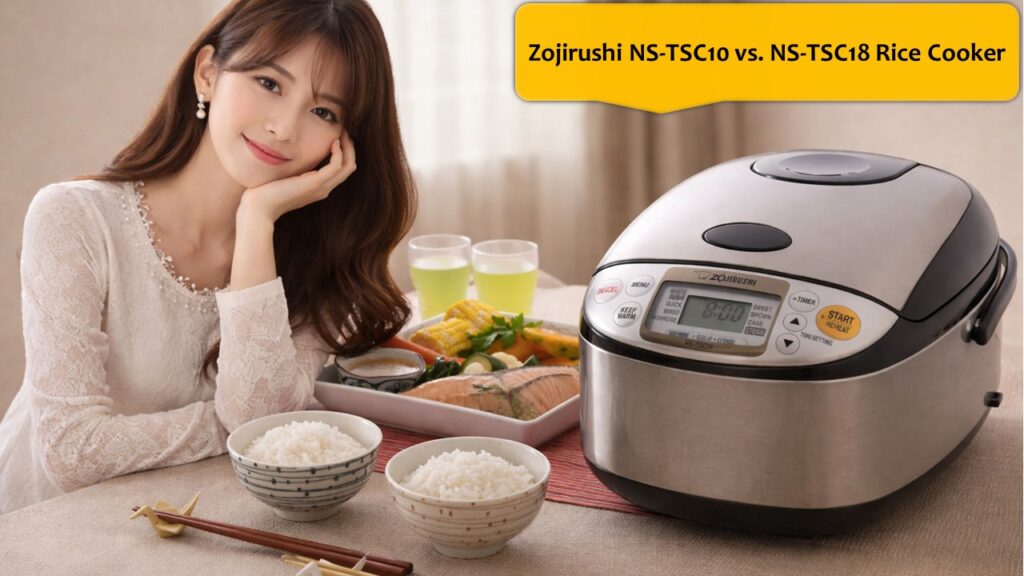
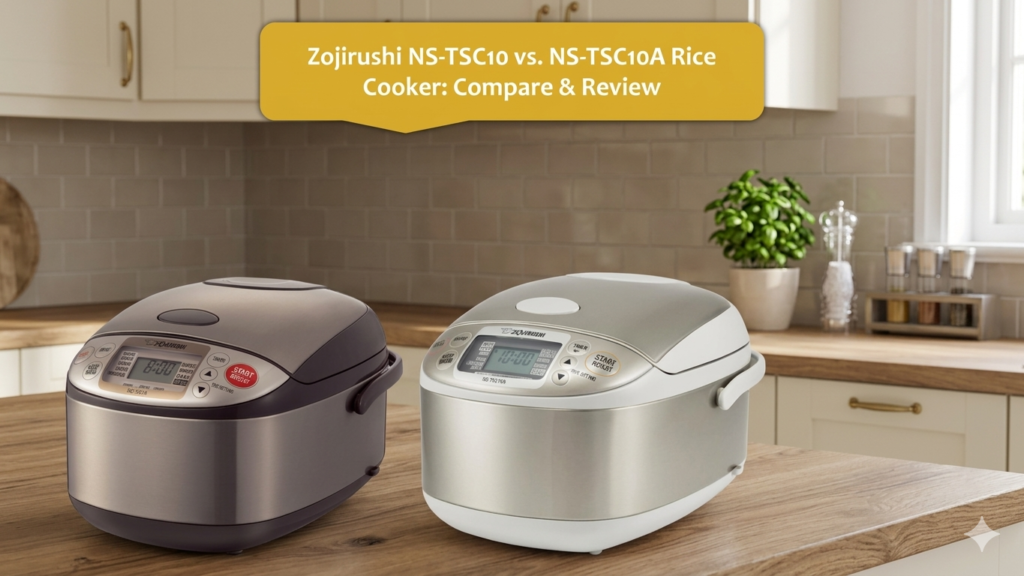
There is a specific kind of kitchen peace that comes from owning a Zojirushi. It’s the confidence that no matter how distracted you get, your rice will be fluffy, sweet, and perfectly hydrated. For years, the Zojirushi NS-TSC10 has been the gold standard for mid-range Micom (micro-computerized) cookers. However, the arrival of the Zojirushi NS-TSC10A has left many home cooks wondering: is this a groundbreaking upgrade or just a subtle cosmetic shift?
After putting both 5.5-cup models through their paces – cooking everything from delicate jasmine rice to heavy brown grains and even a few sponge cakes – I’ve discovered that these two machines are more like “Version 1.0” and “Version 1.1.” While they share the same legendary “Fuzzy Logic” brain, the newer “A” model introduces subtle refinements in build quality and heat distribution that cater to the modern kitchen.
If you are trying to decide whether to stick with the classic or opt for the latest iteration, here is my hands-on breakdown of how these two stainless steel siblings performed on my countertop.
The Key Difference: Zojirushi NS-TSC10 vs. NS-TSC10A Rice Cooker
The fundamental divide between the Zojirushi NS-TSC10 and the NS-TSC10A is Component Evolution and Spatial Dimensions.
- The Zojirushi NS-TSC10 (The Original Icon) is the foundation. It established the 610-watt Micom system and the versatile “Steam” and “Cake” menu settings. It is a lower-profile machine (8.5 inches high), making it a favorite for those with tight vertical clearance under their cabinets.
- The Zojirushi NS-TSC10A (The Modernized Update) is a refined SKU that often features updated internal sensors and a slightly modified Black Thick Inner Cooking Pan. While the cooking menus are identical, the 10A is designed with modern manufacturing tolerances in mind, often resulting in a more responsive LCD and slightly improved heat retention during the “Extended Keep Warm” phase.
Essentially, the NS-TSC10A is the “current production” standard, ensuring that the legendary reliability of the original is backed by updated internal electronics.
Comparison Table: NS-TSC10 vs. NS-TSC10A Rice Cooker
| Feature | Zojirushi NS-TSC10 | Zojirushi NS-TSC10A |
| Capacity | 5.5 Cups (Uncooked) | 5.5 Cups (Uncooked) |
| Technology | Micom Fuzzy Logic | Micom Fuzzy Logic |
| Wattage | 610 Watts | 610 Watts (Optimized) |
| Inner Pan | Nonstick Coated | Black Thick Inner Pan |
| Retractable Cord | Yes | Yes |
| Cake Setting | Yes | Yes |
| Steam Basket | Included (BPA-Free) | Included (BPA-Free) |
| Dimensions | 14″D x 10.13″W x 8.5″H | 9.4″D x 12.4″W x 15.7″H |
| Exterior | Clear Coated Stainless | Clear Coated Stainless |
| View Current Price On Amazon | View on Amazon | View on Amazon |
Detailed Comparative Review: My Kitchen Observations
-
Design: The Subtle Shift in Footprint
The NS-TSC10 is a masterpiece of low-profile design. At only 8.5 inches tall, it fits comfortably on my “coffee station” counter where vertical space is a premium. The clear-coated stainless steel finish is incredibly durable; even after months of use, it looks as shiny as the day I unboxed it.
The NS-TSC10A feels a bit more “upright” in its stance. While the footprint is nearly identical, the slightly different housing design (often listed at 15.7 inches in height depending on the specific sub-model) gives it a more prominent presence. One thing I love about both is the built-in retractable power cord. It sounds like a small detail until you realize how much cleaner your kitchen looks without a tangled black cord snaking across the granite.

- Micro computerized fuzzy logic technology. Capacity Up to 5.5 cups / 1.0 liter,Dimensions (W x D x H) 10-1/8 x 14 x 8-1/2 inches. The electrical rating is 120 volts...
- Automatic keep warm, extended keep warm and reheating cycle

- Automatic Adjustments: The microcomputer automatically adjusts cooking temperature and time
- Retractable Power Cord: It features a built-in retractable power cord for easy storage
-
Ease of Use: The Logic Behind the Grain
The “Fuzzy Logic” in these machines is what separates them from the $20 “on/off” cookers. It allows the machine to adjust the temperature in real-time, essentially “feeling” how the rice is cooking.
- Operating the NS-TSC10: The interface is classic Zojirushi – big, tactile buttons and a clear LCD. I used the “Quick Cook” mode on a busy Tuesday, and while it skips some of the soaking time, the result was still vastly superior to anything I could do on a stovetop.
- Operating the NS-TSC10A: I noticed the LCD on the 10A feels a bit more modern – sharper contrast and easier to read from an angle. Setting the Delay Timer (which has two memory settings) was seamless. I set it for 7:00 AM, and by the time I walked into the kitchen, the machine was playing its “completion melody,” and the rice was perfect.
-
Functions: Multi-Cooking Performance
Both models are famous for their ability to steam and bake, which is a rare find in the Micom category.
- Steaming Side-by-Side: I used the NS-TSC10A to steam a batch of bao buns while cooking white rice underneath. The steam basket is sturdy and doesn’t warp. The “A” model’s thick inner pan seemed to handle the thermal load of simultaneous steaming slightly better, with no noticeable drop in the quality of the rice grains at the very bottom.
- The “Cake” Challenge: I baked a classic chocolate sponge in the NS-TSC10. Because the heating system is so controlled, the cake rose evenly without any “hot spots” or burnt edges. If you’ve never baked a cake in a rice cooker, the 10A makes it incredibly easy – it’s essentially a “set it and forget it” oven for small desserts.
-
Maintenance: The Clean-Up Routine
Zojirushi clearly understands that if an appliance is hard to clean, you won’t use it. Both the 10 and 10A feature a detachable inner lid made of stainless steel.
In my testing of the NS-TSC10A, I found the gaskets to be exceptionally tight. After a cycle of “Mixed Rice” (which uses soy sauce and aromatics), the lid was easy to pop off and rinse. The Black Thick Inner Pan is the star here; the nonstick coating is so effective that most starchy residue simply wipes away with a soft sponge. I’ve found that as long as you hand-wash the pot, these machines can easily last a decade or more.
Zojirushi NS-TSC10 (The Classic Choice) Rice Cooker
- Micro computerized fuzzy logic technology. Capacity Up to 5.5 cups / 1.0 liter,Dimensions (W x D x H) 10-1/8 x 14 x 8-1/2 inches. The electrical rating is 120 volts...
- Automatic keep warm, extended keep warm and reheating cycle
Pros:
- Proven Longevity: Thousands of users report 10+ years of daily use.
- Low Profile: Ideal for kitchens with low cabinet clearance.
- Affordability: Often found at a slightly lower price point than the newer SKU.
- Retractable Cord: Keeps the kitchen looking organized and safe.
Cons:
- Older Sensors: Internal logic is based on older production standards.
- Legacy SKU: May eventually be phased out for the “A” series.
Zojirushi NS-TSC10A (The Modern Refinement) Rice Cooker
- Automatic Adjustments: The microcomputer automatically adjusts cooking temperature and time
- Retractable Power Cord: It features a built-in retractable power cord for easy storage
Pros:
- Enhanced Thermal Mass: Black thick pan provides superior heat distribution.
- Updated Logic: Refined AI sensors for more accurate cooking cycles.
- Sharper LCD: Easier to read under various lighting conditions.
- Modern SKU: Guaranteed to have the latest manufacturing components.
Cons:
- Higher Height: May be a tighter fit for some appliance garages.
- Price: Often carries a slight premium for the “newer” designation.
The Verdict: Which Zojirushi Should You Choose?
After weeks of back-to-back testing, the decision really comes down to availability and space.
I recommend the Zojirushi NS-TSC10 if: You have very low cabinets and need a machine that sits closer to the counter. If you find a great deal on this original model, take it – the core cooking performance is still 95% of what the newer model offers.
I recommend the Zojirushi NS-TSC10A if: You are starting from scratch and want the most up-to-date version of this kitchen legend. The refinements in the thick inner pan and the updated internal sensors make it the “perfected” version of the TSC series. It’s the smarter long-term investment for a 2026 kitchen.
My Personal Choice: I am sticking with the Zojirushi NS-TSC10A. The improved heat retention of the thicker pan makes a subtle but noticeable difference in the “mouthfeel” of brown rice, which is a staple in my house.
Frequently Asked Questions
-
Is the NS-TSC10A an Induction Heating (IH) model?
No. Both the NS-TSC10 and the 10A are Micom Fuzzy Logic cookers. They use a heating element at the base. While IH models are more expensive and heat the entire pot magnetically, the Micom series is often preferred because it allows for the “Cake” and “Steam” settings.
-
Can I use the “Cake” setting for anything else?
I’ve seen some creative cooks use the Cake setting for “giant pancakes” or even thick frittatas. However, it is primarily optimized for sponge-style cakes.
-
How long does a “Quick Cook” cycle take?
On both models, the Quick Cook setting takes about 35-40 minutes. It’s faster than the standard 50-60 minute cycle because it shortens the soaking and steaming phases.
-
Why is the retractable cord such a big deal?
Standard cords are often too long, leaving a mess on the counter, or too short, limiting where you can place the machine. The retractable cord lets you pull out exactly what you need and stores the rest safely inside the chassis.
-
Does the NS-TSC10A come with a warranty?
Yes, Zojirushi typically offers a 1-year limited warranty on their rice cookers. Because they are “Made in China” (to keep the price accessible compared to the $500 “Made in Japan” models), they are built to very strict Zojirushi quality standards.