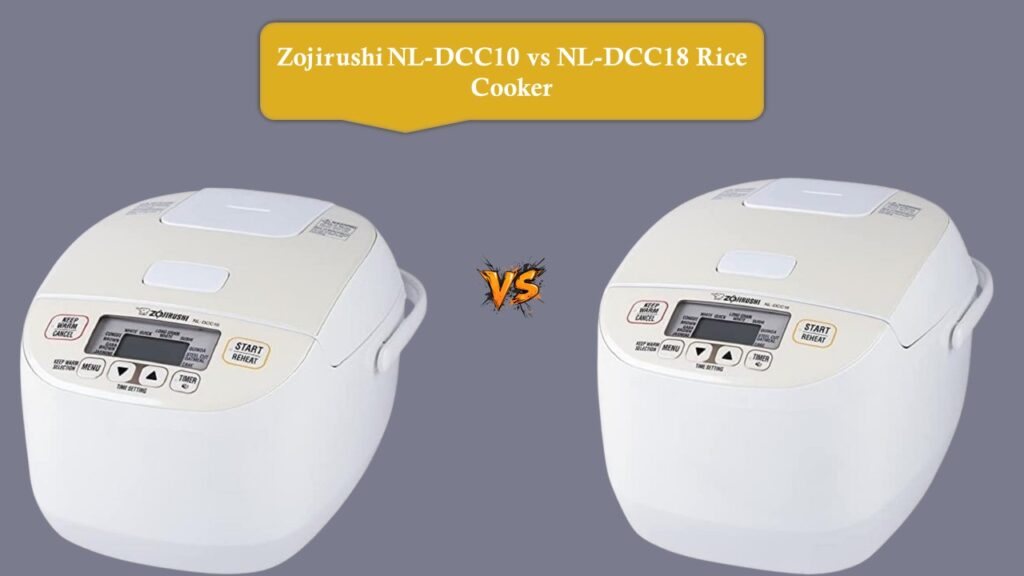
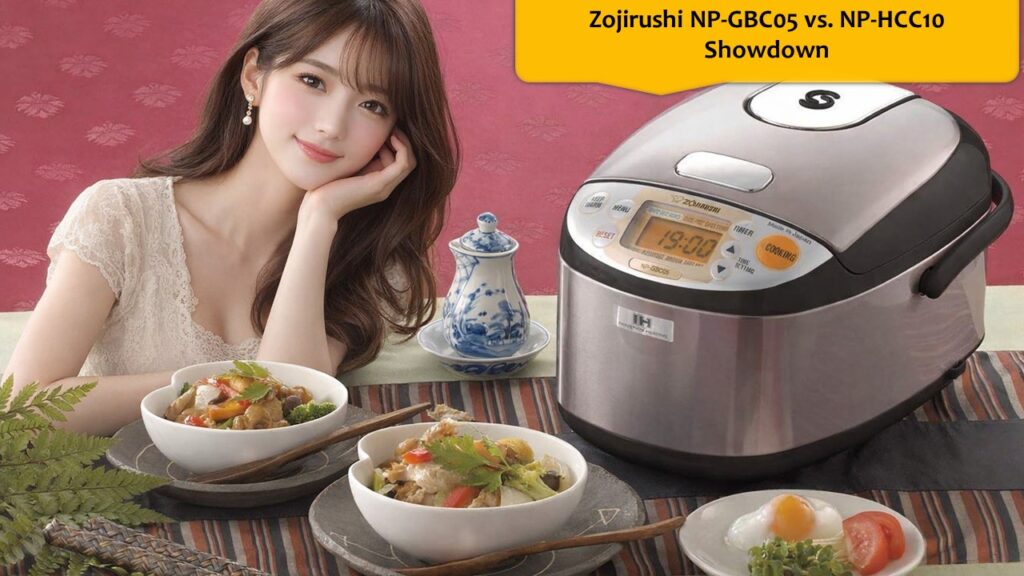
Walking into my kitchen on a Sunday morning, the air usually carries the faint, nutty aroma of GABA brown rice – a scent that has become the “home” signal for my family. But lately, my countertop has been a battleground for two of the most respected names in the induction world: the Zojirushi NP-GBC05 and the Zojirushi NP-HCC10.
Both belong to the elite “Induction Heating” (IH) family, which means they don’t just heat from the bottom like a standard $20 pot; they use electromagnetic coils to turn the entire inner pan into a heat source. However, after weeks of measuring out 6.1-ounce cups and listening to the signature “Twinkle, Twinkle, Little Star” chime, I’ve realized that these two machines are designed for completely different life stages. One is a compact, over-engineered masterpiece for the solo diner, while the other is a high-capacity powerhouse designed to be the heart of a busy household.
If you’re staring at the “Stainless Dark Brown” and “Stainless Dark Gray” finishes wondering if you should go small or go big, let’s peel back the lid on my actual experience with both.
The Key Difference: Zojirushi NP-GBC05 vs NP-HCC10 Rice Cooker
The fundamental divide between these two is not just the size of the footprint, but the Targeted Volume Efficiency.
- The Zojirushi NP-GBC05 (3-Cup) is a Small-Batch Specialist. It features a 0.54-liter capacity (up to 3 uncooked cups) and a 700-watt motor. It is uniquely designed to handle as little as half a cup of rice without burning it, making it ideal for singles, couples, or small apartments.
- The Zojirushi NP-HCC10 (5.5-Cup) is a Family-Sized Workhorse. With a 1.0-liter capacity (up to 5.5 uncooked cups) and a more powerful 1,230-watt motor, it is designed for consistent large-batch production. It also includes “Triple Heater” technology (bottom, side, and lid) to ensure that even when the pot is full, every grain receives identical heat.
Essentially, the NP-GBC05 is about precision in small portions, while the NP-HCC10 is about consistency in volume.
Comparison Table: Zojirushi NP-GBC05 vs NP-HCC10 Rice Cooker
| Feature | Zojirushi NP-GBC05 (3-Cup) | Zojirushi NP-HCC10 (5.5-Cup) |
| Max Capacity | 3 Cups (0.54L) | 5.5 Cups (1.0L) |
| Heating Tech | Induction Heating (IH) | Induction Heating (IH) |
| Wattage | 700 Watts | 1,230 Watts |
| Color | Stainless Dark Brown | Stainless Dark Gray |
| Country of Origin | Made in Japan | Made in Japan |
| Special Settings | Rinse-free, Porridge, GABA | Jasmine, GABA, Germinated Brown |
| Power Cord | Detachable | Corded (Non-Retractable) |
| Dimensions | 11.88″D x 9.13″W x 7.5″H | 14″D x 10″W x 8″H |
| View Current Price on Amazon | View on Amazon | View on Amazon |
Detailed Comparative Review: Living with the “Zojis”
-
Design and Kitchen Footprint: “Cute” vs. “Commanding”
When I first unboxed the NP-GBC05, I was struck by how compact it actually is. It has a “Stainless Dark Brown” finish that looks incredibly sophisticated and fits perfectly on my smaller coffee-station counter. The built-in carrying handle and the detachable power cord make it a breeze to move around or even tuck away in a cupboard if I need the counter space for meal prep.
The NP-HCC10, in its “Stainless Dark Gray,” is a much more permanent fixture. It is roughly 2 inches wider and 2 inches deeper, which doesn’t sound like much until you try to put a cutting board in front of it. It feels heavier and more industrial. One quirk I noticed: unlike the smaller model, the HCC10 has a fixed cord. You have to be careful with cord management if your outlets are close to the machine.

- 700-watt 3-cup rice cooker and warmer with Induction Heating technology. Note - Capacity is measured in the approx. 6 oz. / 180mL rice measuring cup, using raw short...
- Menu settings include: white/mixed, sushi, porridge, brown, GABA brown, rinse-free and quick cooking. Electrical Rating- 120 volts / 700 watts

- Induction rice cooker and warmer. Electrical Rating : 1,230 Watts
- Multi-Menu cooking functions. Dimension: 10 inch W x 14 inch D x 8 inch H. Capacity: Up to 5.5 cups / 1.0 liter
-
Ease of Use: The Small-Batch Struggle
This is where the NP-GBC05 truly shines in my day-to-day life. I often want just a small scoop of rice to go with a salmon fillet for lunch. In a standard 5.5-cup cooker, cooking just 0.5 cups of rice often results in a thin layer that gets a bit too “crispy” on the bottom.
In the GBC05, that half-cup came out perfectly – plump, individual grains with zero scorching. The Spherical Inner Pan is noticeably thick, which helps retain heat even when the volume is low. On the other hand, the NP-HCC10 is clearly happier when you’re cooking 2 cups or more. When I filled it to its 5.5-cup capacity for a family dinner, the “Triple Heater” system really flexed its muscles. There was no condensation dripping from the lid onto the top layer of rice – a common flaw in cheaper models.
-
Functions and Performance: The Brown Rice Test
I put both machines through the “GABA Brown Rice” gauntlet. This setting stays at 104°F for two hours before cooking to “activate” the rice, increasing its nutritional value and softening the texture.
- NP-GBC05 Performance: The brown rice was remarkably soft. Because the machine is smaller, the heat distribution felt very intimate and controlled. It’s perfect for someone who is health-conscious but only cooking for one or two.
- NP-HCC10 Performance: This model adds a dedicated Jasmine Rice setting, which the smaller model lacks. As someone who loves Thai food, this was a massive “win” for the HCC10. Jasmine rice can be finicky; it often turns to mush if the temperature stays high for too long. The HCC10 handled it with a lighter touch, resulting in fragrant, fluffy grains that didn’t clump together.
-
Maintenance: The Clean-Up Ritual
Both machines have a clear-coated stainless steel exterior that resists fingerprints quite well, but the real work is on the inside.
- NP-GBC05: The inner lid is stainless steel, detachable, and very easy to rinse. Because the pot is smaller, it fits in the sink much more comfortably for a hand-wash.
- NP-HCC10: The inner lid is also detachable, but because it’s larger, it has a bit more surface area for starch to cling to. It’s still a simple process, but you’ll find yourself wiping down the larger “Triple Heater” lid area more often to keep it pristine.
Zojirushi NP-GBC05 (The Soloist)
- 700-watt 3-cup rice cooker and warmer with Induction Heating technology. Note - Capacity is measured in the approx. 6 oz. / 180mL rice measuring cup, using raw short...
- Menu settings include: white/mixed, sushi, porridge, brown, GABA brown, rinse-free and quick cooking. Electrical Rating- 120 volts / 700 watts
Pros:
- Perfect for Small Portions: Handles 0.5 to 3 cups with elite precision.
- Portable: Carrying handle and detachable cord are great for storage.
- Build Quality: Made in Japan with high-grade materials.
- Efficiency: 700 watts is gentler on your electricity bill for daily use.
Cons:
- No Jasmine Setting: You have to use the “White Rice” setting and adjust water manually.
- Small Capacity: If you have guests over, you’ll be making multiple batches.
Zojirushi NP-HCC10 (The Workhorse)
- Induction rice cooker and warmer. Electrical Rating : 1,230 Watts
- Multi-Menu cooking functions. Dimension: 10 inch W x 14 inch D x 8 inch H. Capacity: Up to 5.5 cups / 1.0 liter
Pros:
- High Capacity:5 cups easily feeds a family of four with leftovers.
- Jasmine Setting: A must-have for fans of aromatic long-grain rice.
- Triple Heater: Prevents soggy top layers and condensation buildup.
- Texture Control: Offers “Softer” or “Harder” white rice options.
Cons:
- Bulkier: Requires dedicated counter real estate.
- Fixed Cord: Less convenient for storage than the detachable version.
- Power Draw: 1,230 watts means you shouldn’t run it on the same circuit as a toaster.
The “Real World” Verdict: My Recommendation
After weeks of testing, my choice depends entirely on your Household Size.
Choose the Zojirushi NP-GBC05 if: You live alone, with a partner, or in a space where every square inch of counter matters. It is arguably the best 3-cup induction cooker on the planet. Its ability to cook tiny amounts of rice with “big cooker” quality is a rare find. It’s the perfect companion for a minimalist, high-quality lifestyle.
Choose the Zojirushi NP-HCC10 if: You cook for three or more people, or if you are a “Meal Prepper.” The added Jasmine setting and the ability to cook over 5 cups of rice make it much more versatile for a busy home. It is a “buy once, cry once” investment that will likely sit on your counter for the next decade, providing perfect rice every single time.
My Personal Take: I personally keep the NP-HCC10 on the counter. The dedicated Jasmine setting and the extra capacity for when friends come over make it the more “future-proof” appliance for my lifestyle.
Frequently Asked Questions
-
Why does it take so long to cook (45-60 minutes)?
This is the “Fuzzy Logic” at work. Unlike a cheap on/off cooker, Zojirushi spends the first 15-20 minutes “soaking” the rice at a precise temperature. This ensures the water reaches the core of the grain before the high-heat boiling phase begins. This is why the rice never comes out crunchy or uneven.
-
Can I use a metal spoon in the inner pan?
No. Both models use a high-quality non-stick coating. While it is durable, using metal will eventually scratch it. Always use the included plastic spatula (shamoji) or a silicone alternative to keep the pan in “BIFL” (Buy It For Life) condition.
-
What is the “Rinse-Free” setting on the NP-GBC05?
This is a popular setting in Japan for “Musenmai” rice, which has already been polished to remove the starch. If you buy standard rice from a US grocery store, you should still wash it and use the regular “White” setting.
-
Is the NP-HCC10 loud?
It makes a slight humming noise while the induction coils are cycling on and off, but it’s very quiet. The loudest part is the musical chime at the beginning and end – which you can actually change to a beep or “silent mode” if you prefer.
-
Why do I need to measure with the included cup?
A standard “US Cup” is 240ml, but a “Rice Cooker Cup” is based on the Japanese gō (180ml). If you use a standard measuring cup, the water lines inside the pot will be completely wrong and your rice will be a soggy mess. Stick to the “Zoji Cup”!