There is a specific, high-tech satisfying click that happens when you lock a 1800-watt motor into place. It’s the sound of knowing that no matter how many frozen strawberries or “woody” kale stems you throw into the pit, they aren’t coming out as chunks. Over the last few weeks, my kitchen has been the staging ground for Ninja’s newest “smart” era blenders: the Ninja TB201 Detect Power Blender Pro and its better-equipped sibling, the Ninja TB301.
These machines represent a departure from the “press a button and hope” days of blending. They feature what Ninja calls BlendSense, a technology that supposedly “feels” the resistance of the food and adjusts the torque and time accordingly. It’s essentially a brain for your blender. But after liquefying a small mountain of frozen fruit and enough salsa to feed a stadium, I’ve found that while the “brains” inside these two are identical, the way they fit into your life depends entirely on how often you find yourself running out the door with a smoothie in your hand. One is a focused pitcher-only machine; the other is a full-spectrum blending system.
The Key Difference: The Single-Serve Ecosystem
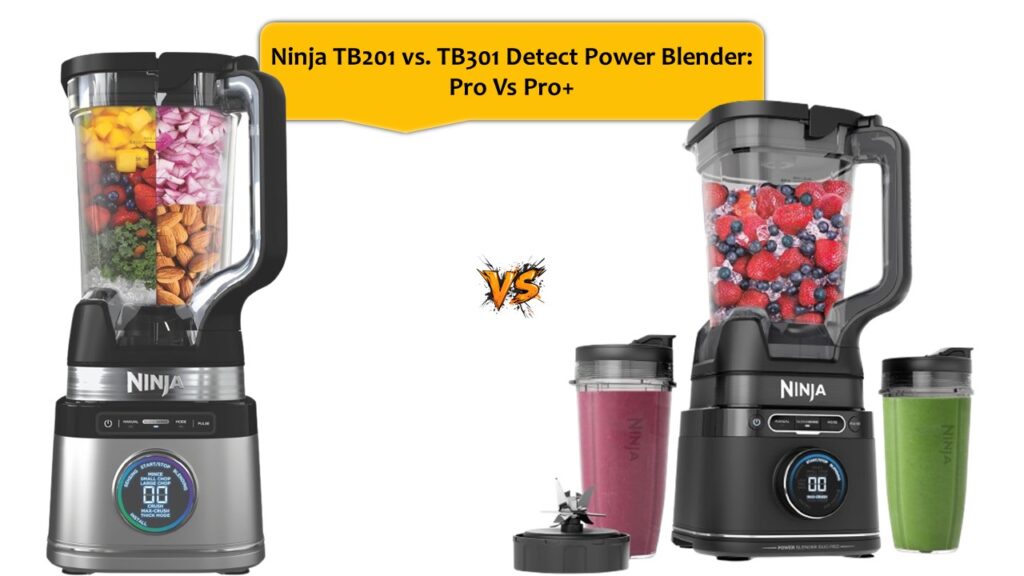
The fundamental difference between the Ninja TB201 and the Ninja TB301 is the accessory package and the Liquid Detect feature. Both blenders use the exact same 1800 peak watt motor base and 72-oz. Total Crushing Pitcher. However, the Ninja TB301 includes two 24-oz. single-serve cups with spout lids and a specialized Hybrid Edge Blade assembly.
Crucially, the TB301 also features Liquid Detect technology, which is exclusive to the single-serve cups and alerts the user if more liquid is required to complete the blend. The TB201 is strictly a pitcher-based blender, designed for those who exclusively prepare large batches.
Comparison Table: Ninja TB201 vs. TB301 Blender
| Feature | Ninja TB201 Detect Pro | Ninja TB301 Detect Pro+ |
| Peak Wattage | 1800 Watts | 1800 Watts |
| Core Technology | BlendSense & Auto-iQ | BlendSense, Auto-iQ & Liquid Detect |
| Primary Container | 72-oz. Total Crushing Pitcher | 72-oz. Total Crushing Pitcher |
| Personal Blending | No | (2) 24-oz. Cups + Hybrid Edge Blades |
| Variable Speed | Yes (Manual Dial) | Yes (Manual Dial) |
| One-Touch Chop | Yes | Yes |
| Color | Silver / Black | Black / Silver Accent |
| Dimensions | 6.88″D x 8.38″W x 17.5″H | 6.88″D x 8.38″W x 17.5″H |
| Dishwasher Safe | Yes (Top Rack) | Yes (Top Rack) |
| View Current Price on Amazon | View on Amazon | View on Amazon |
Detailed Comparative Review: My Experience with the “Detect” Series
To truly test the “Detect” claims, I treated these blenders with a level of neglect I usually wouldn’t—throwing in whole un-chopped veggies and solid ice blocks—to see if the sensors actually worked.
Design: Identical Power in Different Packages
Walking into the kitchen, you’d be hard-pressed to tell the motor bases apart. They both feature the new, sleek Ninja aesthetic: a central dial that glows with information and a clean, digital interface. Both the TB201 and TB301 are quite tall at 17.5 inches. They barely fit under my standard cabinets when the pitcher is attached, so keep that in mind if you have a low-hanging kitchen setup.
The TB301 feels like the more complete “station.” Because it comes with the personal cups, I found myself leaving the base out on the counter more often. The TB201 is a beast of a pitcher-blender, but because it only does large batches, I felt more inclined to put it away when I wasn’t making margaritas or family-sized smoothies.
Ease of Use: Let the Machine Do the Thinking
The BlendSense dial is the star of the show. On both models, you don’t just choose “High” or “Low.” You hit the BlendSense button, and the dial starts a countdown. I watched it in real-time as it detected a thick pocket of frozen mango; the machine actually sped up and then pulsed to let the ingredients fall back down.
In the TB301, the Liquid Detect feature saved me from a “stuck” smoothie. I tried to blend a particularly dry protein shake in the 24-oz. cup, and the base actually flashed an alert telling me to add more liquid. This is a massive “quality of life” improvement over older models where the motor would just hum and smoke while the blades spun in an air pocket. The TB201 handles the pitcher beautifully, but you miss out on that specific, cup-based sensor technology.
Functions: Pitcher Power vs. Cup Convenience
The 72-oz. pitcher included with both is legendary for a reason. It uses the “stacked” blade tower that Ninja is famous for. For crushing ice into snow for a frozen drink, nothing beats it. Both the TB201 and TB301 handled a full pitcher of ice in under 30 seconds.
However, when it came to a single-serving green smoothie, the TB301 was the clear winner. Using the stacked blades in a large pitcher for one small drink is inefficient—half the smoothie sticks to the sides of the massive pitcher. The TB301’s Hybrid Edge Blades in the 24-oz. cup are much better at pulverizing seeds and skins in small volumes. If you’re a “smoothie for breakfast” person, the TB201 is going to frustrate you with the amount of cleaning required for a single cup of juice.
Maintenance: The Top-Rack Life
Both machines are remarkably easy to clean. Ninja has finally moved away from the “finger-slicing” terror of some older designs. The containers, lids, and even the blade assemblies are BPA-free and top-rack dishwasher safe.
In my first-person experience, cleaning the TB301 cups was much faster than cleaning the TB201 pitcher. The pitcher has the removable blade tower, which is effective but requires careful handling. With the personal cups on the TB301, you just rinse the blade cap and throw the cup in the washer. If you’re someone who prioritizes a 2-minute cleanup, the TB301 wins purely on the simplicity of its accessory set.
Ninja TB201 Detect Power Blender Pro
Pros:
- Unmatched Pitcher Power: 1800 watts makes short work of family-sized batches.
- BlendSense Intelligence: The dial effectively manages speed and timing for you.
- Variable Speed Control: Great for those who want manual control over their salsa texture.
- Price: A more affordable way to get the most powerful Ninja motor base.
Cons:
- No Single Serve: Not ideal for individuals or small batches.
- No Liquid Detect: Lacks the sensor that tells you when to add water.
- Bulkier Cleanup: You have to wash the large pitcher even for small jobs.
Ninja TB301 Detect Power Blender Pro+
Pros:
- The Complete Package: Handles both massive party batches and personal smoothies.
- Liquid Detect: Prevents “blender stalls” in the single-serve cups.
- Two 24-oz. Cups: Perfect for couples or meal-preppers.
- Versatility: The Hybrid Edge blades provide a smoother texture for small-batch drinks.
Cons:
- Higher Price: You pay a premium for the extra accessories and sensors.
- Storage: More parts (lids, blades, cups) to store in your cabinets.
The Final Recommendation: Which “Detect” Model Wins?
After putting both through the ringer, the decision is surprisingly binary.
I recommend the Ninja TB201 if you are a “large batch” cook. If you mainly use your blender for Sunday meal prep, making large batches of soup, or hosting cocktail parties where the pitcher is always full, the TB201 is the most cost-effective way to get Ninja’s smartest motor. You aren’t paying for cups you’ll never use.

- 1800 PEAK WATT MOTOR BASE: Made for powering through the toughest of ingredients.
- BLENDSENSE: Ninja’s Smartest Technology that can automatically adjust speed and time for perfectly smooth results. Innovative dial informs user what mode the...
I recommend the Ninja TB301 if you are a daily smoothie drinker. The inclusion of the 24-oz. cups and the Liquid Detect technology turns this from a “blender” into a “daily companion.” The ability to blend in the cup you drink from is the ultimate convenience, and the smarter sensors in the cup mode make it virtually impossible to mess up a smoothie.

- 1800 PEAK WATT MOTOR BASE: Made for powering through the toughest of ingredients.
- BLENDSENSE: Ninja’s smartest technology that can automatically adjust speed and time for perfectly smooth results. Innovative dial informs the user what mode the...
For me, the Ninja TB301 is the clear choice. The versatility of having both the 72-oz. pitcher for the weekend and the 24-oz. cups for the work week makes it one of the most useful appliances I’ve ever tested.
Frequently Asked Questions (FAQs)
Q: Can I buy the cups later for the TB201?
A: While Ninja sells cups separately, you should be aware that the Liquid Detect feature is hard-coded into the base’s interaction with the cup. Check your specific model number on the Ninja site to ensure compatibility, as the TB201 base is sometimes tuned specifically for the pitcher.
Q: Is 1800 watts too much for a smoothie?
A: Never. The higher the wattage, the less the motor has to “struggle.” This means the blender stays cooler, lasts longer, and produces a silkier texture than a 600-watt “bullet” style blender.
Q: Does it actually “detect” ingredients?
A: It detects resistance. If you put in rocks, it wouldn’t know they are rocks, but it would know the blades are hitting something very hard and would adjust the power output accordingly to protect the motor.
Q: Is the TB301 louder than the TB201?
A: They use the same motor base, so the decibel level is identical. Ninja blenders are loud (around 95-100 dB). It’s not a “quiet morning” machine, but the speed of the blend means it’s over quickly.
Q: Can it make hot soup?
A: While it can blend hot ingredients, the Ninja Detect series does not have a heating element. To make hot soup, you must blend your cooked ingredients and then heat them on a stove (or use the friction of a 6-minute blend, though this is not a dedicated soup-maker like the Foodi Heat Cold model).