There is a specific moment when you realize that not all rice is created equal. It usually happens the first time you taste a bowl from a Pressure Induction Heating (IH) machine. Unlike standard cookers that simply boil grains, these flagship models from Zojirushi use pressurized environments to literally transform the starch structure of the rice, making it sweeter, plumper, and more digestible.
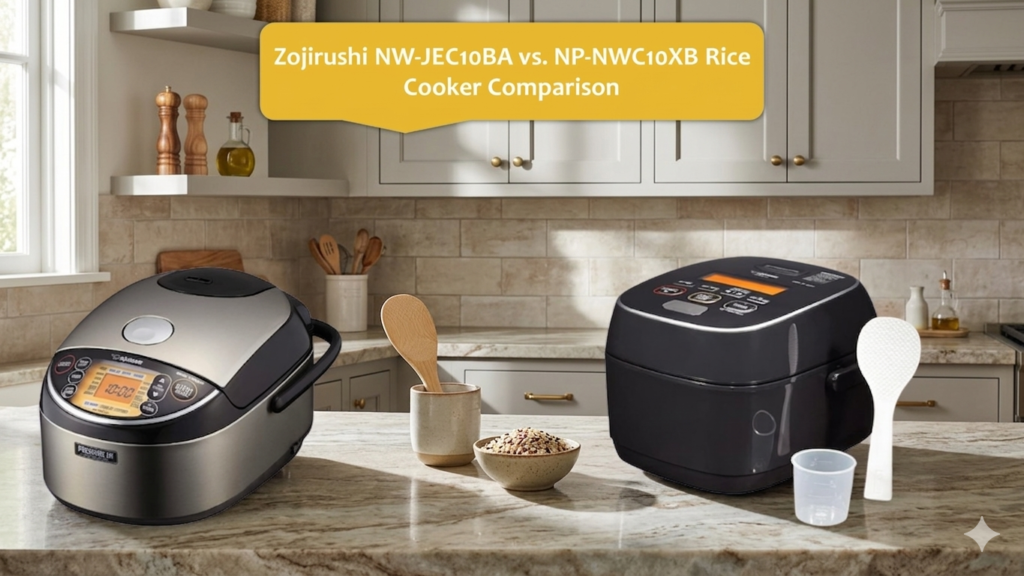
Lately, I’ve been living with two of the most advanced 5.5-cup models on the market: the Zojirushi NW-JEC10BA and the Zojirushi NP-NWC10XB. Both are Made in Japan. Both utilize Artificial Intelligence. Both represent a significant financial investment in your culinary daily life. However, after weeks of side-by-side testing – cooking everything from delicate Jasmine rice to stubborn steel-cut oatmeal – I discovered that these two machines, while similar on paper, offer distinct user experiences. One feels like a refined, high-tech evolution of the kitchen, while the other is a robust, feature-packed workhorse designed for maximum versatility.
If you are ready to graduate to the “elite tier” of rice cooking but aren’t sure if the extra vertical height or the specific pressure settings of one model over the other truly matter, here is my honest take from the kitchen counter.
The Key Difference: Zojirushi NW-JEC10BA vs NP-NWC10XB Rice Cooker
The fundamental divide between the Zojirushi NW-JEC10BA and the NP-NWC10XB is Pressure Customization and Spatial Design.
- The Zojirushi NW-JEC10BA (The Refined Evolution) is the more compact of the two. It features an advanced pressure system that utilizes 4 different pressure settings to specifically tune the texture of your rice. It is designed with a more modern, streamlined aesthetic that takes up significantly less depth and height on your counter, making it ideal for kitchens with tight space constraints.
- The Zojirushi NP-NWC10XB (The Versatile Powerhouse) is a physically larger unit that prioritizes a wide range of menu presets. While it also uses an automatic 3-level pressure system, it stands out with its “Stainless Black” finish and a more extensive list of specific grain settings, including Steel Cut Oatmeal and Congee. It is built for the cook who wants a dedicated, pre-programmed button for every conceivable grain variety.
Essentially, the NW-JEC10BA offers more granular control over the texture of the rice itself through its specialized pressure levels, whereas the NP-NWC10XB offers more menu variety out of the box.
Comparison Table: Zojirushi NW-JEC10BA vs NP-NWC10XB
| Feature | Zojirushi NW-JEC10BA | Zojirushi NP-NWC10XB |
| Heating Tech | Pressure Induction Heating (IH) | Pressure Induction Heating (IH) |
| Logic System | Advanced Fuzzy Logic with AI | Advanced Fuzzy Logic with AI |
| Pressure Settings | 4 Texture-Specific Settings | 3 Auto-Selected Levels |
| Capacity | 5.5 Cups (1.0 Liter) | 5.5 Cups (1.0 Liter) |
| Grain Presets | White, Umami, Mixed, Sushi, Brown | White, Jasmine, Oatmeal, Congee, Brown |
| Dimensions | 13.62″D x 10.75″W x 8.5″H | 16.5″D x 15.38″W x 10.13″H |
| Origin | Made in Japan | Made in Japan |
| Finish | Black | Stainless Black |
| Included Tools | Self-Standing Spatula, Cup | Spatula, Cup |
| View Current Price On Amazon | View on Amazon | View on Amazon |
Detailed Comparative Review: My Kitchen Experience
-
Design: Compact Elegance vs. Command Center
When I first unboxed the NW-JEC10BA, I was immediately thankful for its footprint. At just 8.5 inches tall, it fits comfortably under my kitchen cabinets even when the lid is closed. It has a sleek, minimalist look that hides its complexity well. The buttons are tactile, and the overall build quality feels incredibly dense – like a piece of precision medical equipment.
The NP-NWC10XB, on the other hand, is an imposing machine. It is significantly deeper (16.5 inches) and taller (over 10 inches). I had to rearrange my appliance garage to make it fit. However, that extra size comes with a massive, easy-to-read interface. The “Stainless Black” finish is beautiful and does an excellent job of hiding fingerprints compared to standard plastic housings. It feels like a “command center” for grains.

Zojirushi NW-JEC10BA Pressure Induction Heating (IH) Rice Cooker & Warmer, 5.5-Cup, Made in Japan
- Capacity Up to 5.5 cups uncooked rice / 1.0 liter
- Pressurized Cooking and Steaming: Promotes gelatinization and produces sticky and plump rice Automatically selects from 3 pressure levels according to the menu selected Utilizes 4 different pressure settings to perfect variety of textures Applies pressure at the end during steaming to burn off excess moisture for best cooking results

Zojirushi Np NWC10XB Pressure Ih Rice Cooker 5.5 Cup (Black)
- Pressurized Cooking and Steaming: Promotes gelatinization and produces sticky and plump rice
- AI (Artificial Intelligence): AI technology learns and adjusts the cooking cycle to get perfect results
-
Ease of Use: Artificial Intelligence in Action
Both of these machines utilize Artificial Intelligence (AI), which is the secret to their consistency. After about five cooks, I noticed that the machines seemed to “learn” how much water I usually use and adjusted the soaking time.
- NW-JEC10BA Experience: Navigating the texture settings was a highlight. If you prefer your sushi rice a bit firmer but your white rice incredibly soft, this machine makes those adjustments effortless. The self-standing spatula included with this model is one of those small design wins that makes a huge difference – no more messy rice-covered counters.
- NP-NWC10XB Experience: This is the machine for the “global pantry.” I love steel-cut oatmeal for breakfast, and having a dedicated button for it meant I didn’t have to guess water ratios or settings. The Jasmine rice setting on the NWC10XB is also exceptionally well-tuned; it managed the delicate fragrance of long-grain rice without the mushiness that sometimes happens in pressurized units.
-
Functions: The Art of Gelatinization
Pressure cooking rice is all about gelatinization – breaking down the starch to create a texture that is both “bouncy” and soft.
- NW-JEC10BA Performance: The 4 different pressure settings are not just for show. I used the highest pressure for brown rice, and the result was the softest, most “white-rice-like” brown rice I’ve ever tasted. The machine also applies a burst of pressure at the very end of the cycle to “burn off” excess moisture. My rice came out perfectly separated every single time.
- NP-NWC10XB Performance: The Umami setting on this model is phenomenal. It extends the soaking and steaming time to draw out more natural sweetness from the rice. While it has one fewer pressure level than the JEC10BA, its automatic selection is incredibly accurate. It produced a “Congee” that was silky and restaurant-quality, which is a difficult texture to achieve at home.
-
Maintenance: Keeping the Perfection Pristine
With high-end rice cookers, the maintenance is all about the inner lid. Because these are pressurized units, they have a more complex lid assembly with a pressure ball and various gaskets.
- Cleaning the NW-JEC10BA: This model was slightly easier to wipe down. The interior is very flat, and the stainless steel inner lid pops off with a simple latch. I usually just rinsed it under warm water after each use.
- Cleaning the NP-NWC10XB: Because of its larger size and more “Stainless” surfaces, it requires a bit more care to keep it looking shiny. The care instructions suggest wiping the exterior with a damp cloth, which is essential because the stainless black finish can show steam spots. Both machines require hand-washing the inner pot; never put these pots in the dishwasher, as the platinum/non-stick coating is what makes the rice cook so evenly.
Zojirushi NW-JEC10BA (The Refined Specialist)
Zojirushi NW-JEC10BA Pressure Induction Heating (IH) Rice Cooker & Warmer, 5.5-Cup, Made in Japan
- Capacity Up to 5.5 cups uncooked rice / 1.0 liter
- Pressurized Cooking and Steaming: Promotes gelatinization and produces sticky and plump rice Automatically selects from 3 pressure levels according to the menu selected Utilizes 4 different pressure settings to perfect variety of textures Applies pressure at the end during steaming to burn off excess moisture for best cooking results
Pros:
- Space-Saving: Compact dimensions fit almost any kitchen layout.
- Texture Control: 4 pressure levels allow for ultimate customization of the “bite” of the rice.
- Modern Accessories: The self-standing spatula is a brilliant, hygienic addition.
- Made in Japan: World-class manufacturing and durability.
Cons:
- Fewer Presets: Doesn’t have the dedicated “Oatmeal” or “Congee” buttons found on the NWC.
- Learning Curve: You have to manually decide on textures rather than just hitting a specific grain button.
Zojirushi NP-NWC10XB (The Versatile Powerhouse)
Zojirushi Np NWC10XB Pressure Ih Rice Cooker 5.5 Cup (Black)
- Pressurized Cooking and Steaming: Promotes gelatinization and produces sticky and plump rice
- AI (Artificial Intelligence): AI technology learns and adjusts the cooking cycle to get perfect results
Pros:
- Menu Variety: Dedicated settings for Jasmine rice, Congee, and Steel-Cut Oatmeal.
- Umami Setting: Produces exceptionally sweet and flavorful white rice.
- Stainless Black Aesthetic: A stunning, premium look for modern kitchens.
- Large Display: Easier to read for those with vision concerns.
Cons:
- Huge Footprint: Requires a lot of counter depth and vertical clearance.
- Heavier: Not a machine you want to be moving in and out of a cabinet frequently.
The Verdict: Which Zojirushi Should You Choose?
After a month of back-to-back testing, the choice boils down to Kitchen Space vs. Menu Variety.
I recommend the Zojirushi NW-JEC10BA if: You have a smaller kitchen or limited counter space. If you are a rice “purist” who wants the highest level of control over the texture of your white and brown rice, the 4-level pressure system in this compact machine is unbeatable. It is the sophisticated choice for a modern, efficient kitchen.
I recommend the Zojirushi NP-NWC10XB if: You want your rice cooker to do everything. If your diet includes a wide variety of grains – Jasmine rice, steel-cut oats, and porridge – the dedicated menu presets on the NWC10XB will make your life much easier. It is a large, beautiful appliance that acts as a true multi-grain station.
My Personal Choice: I am sticking with the Zojirushi NW-JEC10BA. I value the extra counter space, and I found the texture of the rice from its 4-level pressure system to be just a hair more “perfect” for my daily sushi-rice and brown-rice needs.
Frequently Asked Questions
-
Does the pressure make the rice cook faster?
Surprisingly, no. Pressure IH rice cookers aren’t necessarily “fast.” A standard white rice cycle takes about 50–60 minutes. The pressure is used to change the texture and taste by gelatinizing the starch, not to rush the process. Both have a “Quick Cook” mode, but you lose some of that premium texture.
-
Can I use the NP-NWC10XB for regular oatmeal?
Yes, but it is specifically designed for Steel Cut Oatmeal. Regular rolled oats can sometimes bubble up and clog the pressure valve. Always follow the specific water lines inside the pot for the best results.
-
What is the benefit of “Made in Japan” Zojirushis?
Zojirushi’s top-tier models (like these two) are manufactured in Japan with higher-grade components and more rigorous quality control. They generally feature the platinum-infused inner pots and the most advanced AI algorithms.
-
How long can I keep rice “warm” in these?
Both models feature an “Extended Keep Warm” setting. Thanks to the AI and the pressure lid, I’ve kept rice for 24 hours without it turning yellow or drying out. It still tastes freshly cooked even the next day.
-
Why is the spatula “Self-Standing” on the JEC10BA?
It’s a hygienic feature. The spatula has a weighted, flat base, allowing it to stand upright on your counter. This prevents the rice-contact surface from touching the table, keeping your kitchen cleaner.