If you have ever tried to grill a decent steak on a flimsy, ten-dollar portable charcoal tray, you know that “portable” usually means “poor quality.” A few years ago, I decided to stop fighting with uneven heat and rusted-out grates, which led me straight to the Weber Q series. For the past several months, I’ve been alternating between the Weber Q1200 and its bigger, beefier sibling, the Weber Q2200.
These aren’t just scaled-down versions of backyard grills; they are engineered specifically for the rigors of travel. Built with cast aluminum lids and bodies, they are designed to be lightweight enough for a truck bed but heavy-duty enough to hold a steady 500°F temperature in a stiff breeze. However, while they look almost identical in photos, the experience of cooking on them – and more importantly, moving them – is remarkably different.
After a season of tailgating, camping, and mid-week balcony sessions, I’ve broken down exactly where your money is best spent. Whether you are cooking for a solo road trip or a family of five at the lake, the choice between these two comes down to a battle of surface area versus portability.
The Key Difference: Weber Q1200 vs Q2200 Portable Grill
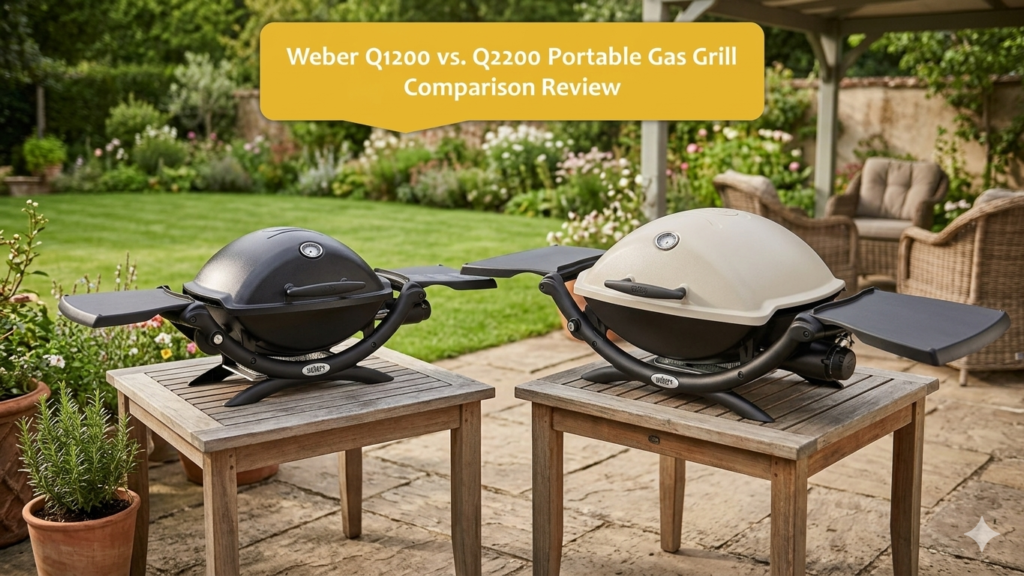
The fundamental divide between the Weber Q1200 and the Q2200 is Grilling Real Estate and Thermal Output.
- The Weber Q1000 (The Solo Traveler) features 189 square inches of cooking space and an 8,500 BTU It is the gold standard for “true” portability. It includes two folding side tables and a lid thermometer, packing professional features into a frame that fits into almost any car trunk.
- The Weber Q2200 (The Family-Sized Commuter) jumps up to 280 square inches of space with a 12,000 BTU It is roughly 30% larger in every dimension, offering a much taller lid profile and wider side tables. It is designed to be a “crossover” grill – something that can live on your patio during the week and head to the campsite on the weekend.
Essentially, the Q1200 is a masterclass in compact efficiency for couples and solo adventurers, while the Q2200 is a high-capacity machine built for those who refuse to cook in “shifts” for a larger group.
Comparison Table: Weber Q1200 vs. Q2200 Gas Grill
| Feature | Weber Q1200 | Weber Q2200 |
| Primary Cooking Area | 189 sq. in. | 280 sq. in. |
| Burner Power | 8,500 BTU/hour | 12,000 BTU/hour |
| Weight | 31 lbs | 44 lbs |
| Ignition System | Electronic (AA Battery) | Electronic (AA Battery) |
| Lid Profile | High-Dome | Extra High-Dome |
| Thermometer | Built-in Lid Gauge | Built-in Lid Gauge |
| Work Tables | 2 Folding Tables | 2 Folding Tables (Larger) |
| Fuel Type | 1lb LP Cylinder (or 20lb w/ adapter) | 1lb LP Cylinder (or 20lb w/ adapter) |
| View Current Price On Amazon | View on Amazon | View on Amazon |
Detailed Comparative Review: Living with the “Q”
-
Design: The Weight of Quality
When I first picked up the Q1200, I was impressed by the balance. At 31 pounds, it’s substantial enough to feel high-end, but light enough that I could carry it with one hand from the garage to the car. The titanium-colored lid is a nice touch, but the real star is the glass-reinforced nylon frame. It provides a sturdy, heat-resistant base that I felt comfortable placing on everything from plastic folding tables to wooden benches.
Moving to the Q2200, the weight jump to 44 pounds is noticeable. You aren’t going to want to carry this one very far by yourself. However, the design rewards you with larger folding work tables. When I was prepping kabobs at a campsite, having those extra few inches of table space to set my marinade and skewers was a game-changer. The cast aluminum construction on both models means they won’t rust – a vital feature for a grill that spends its life outdoors.

Weber Q1200 Liquid Propane Portable Gas Grill, Black – 1‑Burner Travel and Camping Grill with Cast‑Iron Grates & Electronic Ignition…
- The Black Weber Q1200 Travel Grill features porcelain-enameled, cast-iron cooking grates; Grates offer superior heat retention, flavor infusion, and an attractive appearance as you elevate your grilling experience
- 8,500 BTU Burner: Provides robust level of heat output, making outdoor grill highly versatile; Suitable for high-heat searing and lower-temperatures; Fine-tune temperature to suit different cooking methods and foods with the infinite control burner

Weber Q2200 Liquid Propane Grill, Gray
- Total cooking area = 280 Square Inches
- Stainless steel burner
-
Ease of Use: Reliable Fire
Weber has moved away from the old-school “clicky” push buttons to a continuous electronic ignition on both models. I loved the reliability; you just hold the button and it sparks until the gas catches.
- The Q1200 Flow: This grill is a “fast burner.” Because the internal air volume is smaller, the 8,500 BTUs bring the porcelain-enameled cast-iron grates up to searing temperature in about 8-10 minutes.
- The Q2200 Flow: Even with 12,000 BTUs, the larger grate takes a bit more time to fully heat-saturate. However, I found that the Q2200 handles the wind much better. The heavier lid and larger burner seem to maintain a more consistent internal temperature when the weather turns nasty. Both models feature an infinite control burner valve, which allowed me to dial in the heat with much more precision than a standard “High/Medium/Low” knob.
-
Functions: The Versatility of the Dome
The “Q” series isn’t just for burgers; the high-dome lid transforms these into portable ovens.
- Indirect Cooking: On the Q2200, the extra 91 square inches allowed me to push my corn on the cob to the cooler edges while the steaks seared in the center. On the Q1200, that “edge space” is almost non-existent; you are basically cooking everything directly over the burner.
- Large Roasts: I managed to fit a small whole chicken into the Q1200, but it was a tight squeeze. The Q2200 handled a 5-pound bird with room to spare. If you plan on doing “beer can chicken” or roasting a small pork shoulder, the Q2200 is the clear winner due to the vertical clearance.
-
Maintenance: The Grease-Free Life
Both grills utilize a simple, effective Grease Management System. The bottom of the cookbox is sloped toward a central hole that drops drippings into a removable catch pan.
I found that because the Q1200 is smaller, it’s much easier to deep-clean. I could fit the grates into my kitchen sink for a soapy soak when they got particularly nasty. The Q2200 grates are massive and heavy – cleaning them usually required taking them outside with a garden hose. However, the porcelain coating is excellent on both; a quick high-heat burn-off followed by a stainless steel brush was usually all the maintenance I needed.
Weber Q1200 (The Travel Specialist) Portable Grill
Weber Q1200 Liquid Propane Portable Gas Grill, Black – 1‑Burner Travel and Camping Grill with Cast‑Iron Grates & Electronic Ignition…
- The Black Weber Q1200 Travel Grill features porcelain-enameled, cast-iron cooking grates; Grates offer superior heat retention, flavor infusion, and an attractive appearance as you elevate your grilling experience
- 8,500 BTU Burner: Provides robust level of heat output, making outdoor grill highly versatile; Suitable for high-heat searing and lower-temperatures; Fine-tune temperature to suit different cooking methods and foods with the infinite control burner
Pros:
- Ultra-Portable: Fits in almost any car and is easy to carry solo.
- Fast Pre-Heat: Reaches searing temperatures in under 10 minutes.
- Space-Saving: Folding tables make it very compact for storage.
- Durability: The cast-aluminum body is built to last a lifetime.
Cons:
- Limited Capacity: Hard to cook for more than 2-3 people.
- Lower Burner Power: Can struggle slightly in extremely cold, windy weather.
Weber Q2200 (The Portable Powerhouse) Portable Grill
Weber Q2200 Liquid Propane Grill, Gray
- Total cooking area = 280 Square Inches
- Stainless steel burner
Pros:
- Family-Sized: Plenty of room for 10-12 burgers or several large steaks.
- Tall Lid: Great for roasting whole chickens or larger cuts of meat.
- Prep Space: Large side tables are actually useful for food prep.
- Stability: Heavier weight makes it feel like a permanent backyard grill.
Cons:
- Heavy: Requires a bit of muscle (or two people) to move easily.
- Propane Usage: Burns through 1lb cylinders much faster than the Q1200.
The Verdict: Which Weber Wins the Weekend?
After a full season of testing, the “best” grill is entirely dependent on your Group Size and Car Space.
I recommend the Weber Q1200 if: You are a couple, a solo camper, or an apartment dweller with a tiny balcony. If you need a grill that you can easily toss in the back of an SUV and take to a remote beach spot, the Q1200 is perfect. It offers all the high-end features of a Weber without the back-breaking weight.
I recommend the Weber Q2200 if: You have a family of four or you host tailgate parties. The extra cooking space is a massive quality-of-life upgrade that prevents you from having to cook in “shifts.” It is the best portable grill for those who want “home grill” performance in a package they can take camping.
My Personal Choice: I am sticking with the Weber Q2200. Even though it’s a bit heavier to move, the convenience of the larger prep tables and the ability to cook an entire meal (veggies and meat) at the same time makes it the more versatile tool for my lifestyle.
Frequently Asked Questions
-
Can I use a regular 20lb propane tank?
Yes, both models are compatible with an LP Adapter Hose (sold separately). If you are using the grill at home on a patio, this is a much cheaper and more convenient way to fuel it than buying small 1lb cylinders.
-
Is the electronic ignition waterproof?
It is water-resistant, but I wouldn’t leave it uncovered in a downpour. The ignition is powered by a single AA battery, which is tucked away in a protected compartment. If it stops clicking, the first thing to check is that battery!
-
Do I need a special stand?
Both grills are designed to sit on any flat surface. However, if you are at a campsite with no table, the Weber Portable Cart is a great addition. It’s collapsible and makes the grill feel much more like a standard backyard unit.
-
Are the grates interchangeable between the two?
No. The Q1200 uses 1000-series grates, and the Q2200 uses 2000-series grates. They are different sizes and shapes, so you must buy the specific accessories (like griddle inserts) for your model number.
-
Can I cook with the lid open?
I don’t recommend it. These grills are designed to work like convection ovens. Keeping the lid closed traps the heat and allows the cast-iron grates to sear properly. If you leave the lid open, you lose most of your cooking power!