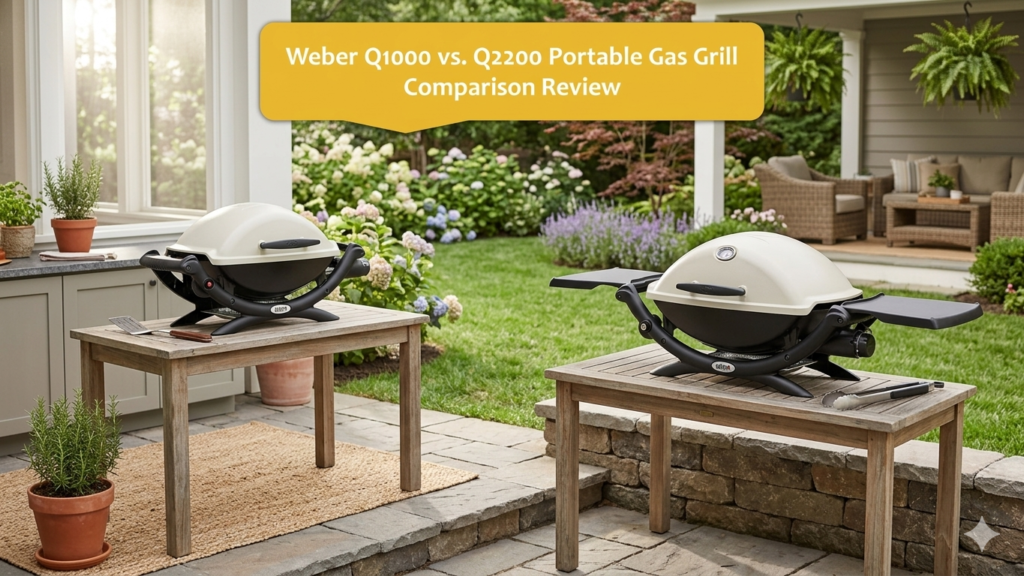
The smell of charcoal is great, but when you are trying to squeeze a grill into the trunk of a sedan for a beach trip or firing up a quick lunch on a cramped apartment balcony, convenience is king. For years, the Weber Q series has been the benchmark for portable gas grilling. Recently, I spent a few weeks living with the two most popular members of the family: the ultra-compact Weber Q1000 and its bigger, more feature-rich sibling, the Weber Q2200.
At first glance, they share that iconic, “space-pod” cast aluminum aesthetic that has made the Q series famous. They both feel indestructible, utilizing heavy-duty materials that put the flimsy, disposable grills found at hardware stores to shame. However, as I moved from simple burger flips to roasting whole chickens and prepping full breakfasts on the beach, the gap between these two models became crystal clear.
One is a minimalist “grab-and-go” tool designed for pure portability. The other is a sophisticated, small-scale outdoor oven that just happens to be portable. Choosing between them isn’t just about how much food you can fit on the grate; it’s about how much control you want over the cooking process and how much gear you’re willing to carry.
The Key Difference: Weber Q1000 vs. Q2200 Gas Grill
The fundamental divide between the Weber Q1000 and the Q2200 comes down to Scale, Preparation Space, and Temperature Monitoring.
- The Weber Q1000 (The Minimalist Traveler) is the definition of “compact.” It offers 189 square inches of cooking space and an 8,500 BTU It lacks side tables and a built-in thermometer, focusing entirely on a small footprint and ease of transport. It uses a simple push-button piezo ignition.
- The Weber Q2200 (The Deluxe Commuter) is a significantly larger machine with 280 square inches of space and a more powerful 12,000 BTU Crucially, it adds two folding side tables for prep work, a built-in lid thermometer, and a more reliable electronic ignition. It also features a taller lid, allowing for larger items like whole chickens to be roasted under the hood.
Essentially, the Q1000 is for the solo traveler or couple who needs a grill that fits anywhere. The Q2200 is for the “crossover” griller – someone who wants a portable grill that is capable enough to serve as a primary home grill for a small family.
Comparison Table: Weber Q1000 vs. Q2200 Gas Grill
| Feature | Weber Q1000 | Weber Q2200 |
| Cooking Area | 189 sq. in. | 280 sq. in. |
| BTU Output | 8,500 BTU/hour | 12,000 BTU/hour |
| Ignition Type | Push-button (Piezo) | Electronic (Continuous) |
| Side Tables | None | Two Folding Work Tables |
| Built-in Thermometer | No | Yes (Lid-mounted) |
| Lid Height | Standard | Tall (For roasting) |
| Weight | ~28 lbs | ~44 lbs |
| Fuel Source | 1lb LP Cylinder (or 20lb tank w/ adapter) | 1lb LP Cylinder (or 20lb tank w/ adapter) |
| Best For | Tailgating, Beach, Small Balconies | Camping, Small Families, Patio use |
| View Current Price On Amazon | View on Amazon | View on Amazon |
Detailed Comparative Review: Real-World Testing
To understand which of these grills belongs in your trunk, you have to look at the “hidden” ergonomics that only show up once you’re actually out in the field trying to sear a steak in the wind.
-
Design: The Battle of Footprint vs. Function
Lifting the Q1000 out of the car is a breeze. At roughly 28 pounds, it’s light enough to carry with one hand using the ergonomic side handles. The design is refreshingly simple; there are no moving parts to rattle around during transport. The cast aluminum body is thick and feels like it could survive being dropped (though I didn’t test that theory).
The Q2200 is a different beast. At 44 pounds, you really notice the extra heft. However, that weight comes with a major design perk: the folding side tables. When I was grilling at a picnic table with limited space, those tables were lifesavers for holding my tongs, a plate of raw burgers, and a bottle of seasoning. The taller lid on the Q2400 also gives the grill a much more “pro” look, though it does make it harder to slide into a packed trunk.
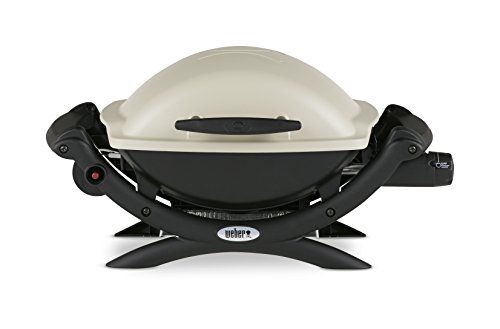
Weber Q1000 Liquid Propane Grill, Chrome
- One stainless steel burner produces 8500 BTU-per-hour to heat 189 square-inch total cooking area
- Porcelain-enameled cast-iron cooking grates and cast aluminum lid and body

Weber Q2200 Liquid Propane Grill, Gray
- Total cooking area = 280 Square Inches
- Stainless steel burner
-
Ease of Use: Ignition and Monitoring
There is a subtle but important difference in how these grills start and run.
- Ignition Experience: The Q1000 uses a classic “click” button. It’s reliable, but sometimes requires two or three presses to catch. The Q2200 features a battery-powered electronic ignition. You just hold the button down, and it clicks rapidly until the gas ignites. It feels much more premium and never failed to light on the first try, even on a breezy afternoon.
- Monitoring the Heat: This is where I struggled with the Q1000. Without a built-in thermometer, I was “flying blind.” I had to rely on my experience to guess the internal temp of the grill. With the Q2200, having that lid-mounted thermometer made it possible to do more than just sear burgers. I was able to maintain a steady 350°F to roast a small pork tenderloin, something I wouldn’t have dared on the Q1000.
-
Functions: Searing vs. Roasting
Both grills utilize porcelain-enameled cast-iron grates, which are the secret sauce of the Weber Q line. They hold heat exceptionally well, allowing you to get those beautiful, professional sear marks even with a portable burner.
- The Q1000 Performance: For burgers, hot dogs, and steaks, the Q1000 is a master. The 8,500 BTUs are concentrated over a smaller area, so the grates get incredibly hot. I found it to be one of the most efficient grills I’ve ever used for quick, high-heat cooking.
- The Q2200 Performance: The 12,000 BTUs provide plenty of power for the larger 280 sq. in. surface. Because the lid is taller, the heat circulates more like a convection oven. I used the “split grate” feature to replace one side with a griddle (sold separately) and made a full breakfast of bacon and eggs on the beach. The extra space meant I wasn’t constantly “Tetris-ing” my food around the grate.
-
Maintenance: The “Drip” Factor
Weber has thankfully used the same grease management system on both. There is a large opening at the bottom of the cook box that funnels everything into a removable catch pan with a disposable aluminum liner.
- Clean-up: Since both use a cast aluminum body, they don’t rust or peel. I found that a quick brush of the grates while they were still hot was all it took to keep them clean. The Q2200 takes slightly longer to wipe down simply because there is more surface area and the side tables occasionally catch a stray drip of sauce. However, the tables are made of a durable, easy-to-clean nylon, so a damp cloth usually does the trick.
Weber Q1000 (The Ultra-Portable) Gas Grill
Weber Q1000 Liquid Propane Grill, Chrome
- One stainless steel burner produces 8500 BTU-per-hour to heat 189 square-inch total cooking area
- Porcelain-enameled cast-iron cooking grates and cast aluminum lid and body
Pros:
- Featherweight: Easy for one person to carry long distances.
- Efficiency: Concentrated heat for perfect high-heat searing.
- Storage: Fits into small storage lockers or small car trunks easily.
- Simplicity: No tables or thermometers to break or rattle.
Cons:
- No Prep Space: You must have a table nearby to hold your tools and food.
- Blind Cooking: No thermometer makes roasting difficult.
- Lower Capacity: You can’t comfortably cook for more than 2-3 people.
Weber Q2200 (The Versatile Deluxe) Gas Grill
Weber Q2200 Liquid Propane Grill, Gray
- Total cooking area = 280 Square Inches
- Stainless steel burner
Pros:
- Side Tables: Massive convenience for prepping and holding tools.
- Thermometer: Allows for precise roasting and baking.
- High Capacity: 280 sq. in. is enough to feed a family of 4-5.
- Tall Lid: Can handle “bulky” foods like a whole chicken or large roasts.
Cons:
- Heavier: 44 pounds is a lot to carry to a remote campsite.
- Footprint: Takes up significantly more space when the tables are extended.
- Price: A higher investment for the added features.
The Verdict: My Final Recommendation
After weeks of flipping burgers and roasting veggies, the choice comes down to Mobility vs. Capability.
I recommend the Weber Q1000 if: You are a solo camper, a tailgater who needs to pack light, or someone with a very small balcony. If your goal is to get a grill to the beach and back with zero fuss, the Q1000 is a perfect piece of engineering. It’s the “purest” form of portable grilling.
I recommend the Weber Q2200 if: You want a grill that can “do it all.” If you have a family of four, the Q1000 will feel frustratingly small. The Q2200, with its built-in thermometer and side tables, is capable enough to be your everyday grill at home while still being portable enough for camping trips.
My Personal Choice: I am sticking with the Weber Q2200. Even though it’s heavier, the convenience of those folding tables and the ability to accurately monitor the temperature makes the grilling experience so much more enjoyable. I’d rather carry the extra 16 pounds to have a place to set my beer and my tongs!
Frequently Asked Questions
-
Can I use a full-sized 20lb propane tank?
Yes! While both are designed to run on the disposable 1lb green cylinders, Weber sells an LP adapter hose. I highly recommend this if you plan on using the grill at home or for long camping trips, as it’s much more cost-effective.
-
Do I need a stand?
Both grills are designed to sit safely on a tabletop (the nylon frame stays cool). However, if you don’t have a table, both are compatible with the Weber Portable Cart. The Q2200 is also compatible with the stationary Q Cart, which makes it feel like a full-sized grill.
-
Is the Q2200 harder to clean?
Not really. The internal grease tray system is identical. The only extra work is occasionally wiping down the side tables if you get a little messy with the BBQ sauce.
-
Can I bake a pizza on these?
You can! Because of the cast-iron grates and the lid design, you can use a small pizza stone. I’ve found the Q2200 is better for this because the lid thermometer helps you ensure the grill is hot enough (usually around 450°F) before you slide the pizza in.
-
Are the grates interchangeable?
No. The Q1000 and Q2200 have different dimensions, so you must buy the specific grates or griddles designed for your series (1000-series vs. 2000-series).