Imagine you’re standing at the edge of a scenic overlook or a bustling stadium parking lot, the trunk is open, and hunger is setting in. In these moments, you don’t need a six-burner monster; you need a reliable, high-performance tool that fits in the backseat. This quest for the ultimate portable companion led me to spend several months alternating between two of the most iconic “baby” Webers: the Weber Q1000 and the Weber Q1200.
At a glance, these two grills look like twins from the same “space-age” design lab. They both feature the signature cast-aluminum clamshell lid, a sturdy glass-reinforced nylon frame, and those heavy-duty porcelain-enameled cast-iron grates that Weber is famous for. They even share the exact same 8,500 BTU burner and 189 square inches of cooking space.
However, after firing them up for everything from sunrise beach breakfasts to sunset steaks, I realized that the “200” in the Q1200 represents a massive leap in user experience. While the Q1000 is a masterclass in minimalist engineering, the Q1200 is a fully-featured outdoor kitchen that just happens to be portable. Choosing between them isn’t about how the food tastes – they both cook beautifully – it’s about how much convenience you want while you’re standing over the flames.
The Key Difference: Utility and Information – Weber Q1000 vs. Q1200
The fundamental divide between the Weber Q1000 and the Q1200 is Workplace Ergonomics and Temperature Awareness.
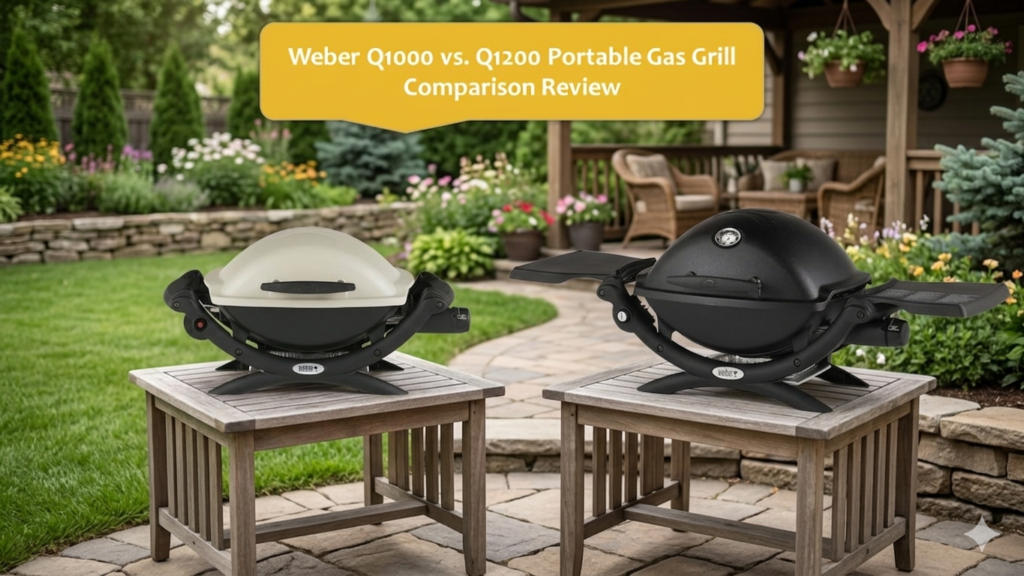
- The Weber Q1000 (The Minimalist) is stripped down for maximum portability. It lacks side tables and a built-in thermometer. It uses a manual push-button piezo ignition (the kind that clicks loudly). It’s designed for the griller who wants the smallest possible footprint and doesn’t mind balancing their plate on their lap.
- The Weber Q1200 (The Deluxe Traveler) adds three critical quality-of-life features: two folding side tables, a lid-mounted thermometer, and a battery-powered electronic ignition. It also features a taller “high-dome” lid, which provides more vertical clearance for bulky foods like a whole chicken or a thick roast.
In short, the Q1000 is the “purest” portable grill for those who prioritize every inch of trunk space, while the Q1200 is the more “complete” grill for those who want a stationary-grill experience in a portable package.
Comparison Table: Weber Q1000 vs. Q1200 Gas Grill
| Feature | Weber Q1000 | Weber Q1200 |
| Cooking Surface | 189 sq. in. | 189 sq. in. |
| Heat Output | 8,500 BTU/hour | 8,500 BTU/hour |
| Lid Design | Standard Dome | High-Dome |
| Side Tables | None | 2 Folding Tables |
| Thermometer | No | Yes (Lid-Mounted) |
| Ignition | Push-Button (Piezo) | Electronic (AA Battery) |
| Weight | ~27 lbs | ~31 lbs |
| Dimensions (Closed) | 14.5″H x 27″W x 16.5″D | 15.5″H x 40.9″W x 20.5″D |
| Color Options | Chrome/Standard | Titanium (Multiple available) |
| View Current Price On Amazon | View on Amazon | View on Amazon |
Detailed Comparative Review: The Hands-On Experience
-
Design: The Balance of Bulk and Beauty
The Q1000 feels like a solid, indestructible nugget of a grill. Because there are no side tables to worry about, it’s incredibly easy to slide into a tight spot in a packed SUV. I found the “chrome” finish on the lid to be classic, and the large grip handles made it a breeze to carry one-handed from the garage to the patio. It feels like a tool that could survive twenty years of being tossed around in a truck bed.
The Q1200 is wider and looks more sophisticated, especially with the Titanium finish. The folding side tables are the most obvious design upgrade. They are made of a rigid, heat-resistant nylon, and I was genuinely surprised by how much weight they could hold. Having a place to set my seasoning and my tongs without walking back to a picnic table changed the flow of my grilling entirely. The high-dome lid is the other major win; it makes the grill look more substantial and, as I found out, allows you to cook much taller items than the Q1000.
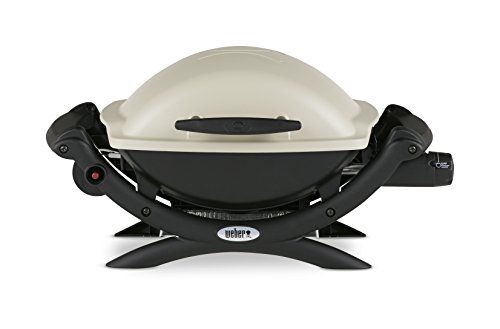
Weber Q1000 Liquid Propane Grill, Chrome
- One stainless steel burner produces 8500 BTU-per-hour to heat 189 square-inch total cooking area
- Porcelain-enameled cast-iron cooking grates and cast aluminum lid and body

Weber Q1200 Liquid Propane Portable Gas Grill, Black – 1‑Burner Travel and Camping Grill with Cast‑Iron Grates & Electronic Ignition…
- The Black Weber Q1200 Travel Grill features porcelain-enameled, cast-iron cooking grates; Grates offer superior heat retention, flavor infusion, and an attractive appearance as you elevate your grilling experience
- 8,500 BTU Burner: Provides robust level of heat output, making outdoor grill highly versatile; Suitable for high-heat searing and lower-temperatures; Fine-tune temperature to suit different cooking methods and foods with the infinite control burner
-
Ease of Use: Ignition and Control
Lighting these grills is where I noticed the first real functional gap. The Q1000 uses a mechanical piezo igniter – you press the button, it makes a loud clack, and a spark jumps. It works, but on a windy day at the beach, I sometimes had to click it four or five times before the gas caught.
The Q1200 features a battery-powered electronic ignition. You just hold the button down, and it creates a rapid-fire stream of sparks. It lit on the first try every single time I used it, even in a brisk crosswind.
Once lit, both grills use an infinite control burner valve. This isn’t just a High-Medium-Low switch; it’s a smooth dial that allows for very fine adjustments. On the Q1200, having the built-in thermometer made this valve much more useful. I could actually see the internal temp drop as I dialed the knob back, allowing me to hit a perfect 350°F for chicken breast. On the Q1000, I was essentially “cooking by ear,” guessing the temperature based on how the sizzle sounded.
-
Functions: Searing Power and Roasting Room
Despite their small size, both grills are “searing machines.” I put a heavy crust on a New York Strip on both, and because the porcelain-enameled cast-iron grates are so thick, they hold onto heat brilliantly.
However, the high-dome lid on the Q1200 gives it a versatility the Q1000 just can’t match. I attempted to roast a whole “beer can” chicken on both. On the Q1000, the lid simply wouldn’t close over the bird. On the Q1200, it fit with room to spare. The extra headspace also means better air circulation, which helps when you’re trying to use the “split-grate” system (replacing one side with a griddle) to make bacon and eggs. The Q1200 just feels less cramped when the lid is down.
-
Maintenance: The Cleanup Routine
Weber has used the same excellent grease management system on both. The bottom of the cookbox is sloped toward a center hole, which funnels everything into a removable catch pan with a disposable liner.
After a weekend of greasy burgers, cleanup was identical for both: I pulled the tray, tossed the liner, and gave the cast aluminum a quick wipe. The cast-aluminum construction is the real hero here – unlike steel grills, it won’t rust or peel, which is essential for a grill that lives its life outdoors. I will say, the Q1200 takes a bit more effort to wipe down simply because the side tables tend to catch some stray grease splatters, but the tables are easy to clean with a damp cloth.
Weber Q1000 (The Pure Portable) Portable Gas Grill
Weber Q1000 Liquid Propane Grill, Chrome
- One stainless steel burner produces 8500 BTU-per-hour to heat 189 square-inch total cooking area
- Porcelain-enameled cast-iron cooking grates and cast aluminum lid and body
Pros:
- Ultra-Compact: Fits in the smallest trunks and storage lockers.
- Lightweight: The easiest model to carry solo over long distances.
- Simple: Fewer parts mean less to maintain or potentially break.
- Price: Generally the most affordable entry point into the Q series.
Cons:
- No Prep Space: You need a nearby table for your tools and food.
- No Thermometer: Harder to master precise cooking or roasting.
- Standard Lid: Vertical clearance is limited for large items.
Weber Q1200 (The Deluxe Traveler) Portable Gas Grill
Weber Q1200 Liquid Propane Portable Gas Grill, Black – 1‑Burner Travel and Camping Grill with Cast‑Iron Grates & Electronic Ignition…
- The Black Weber Q1200 Travel Grill features porcelain-enameled, cast-iron cooking grates; Grates offer superior heat retention, flavor infusion, and an attractive appearance as you elevate your grilling experience
- 8,500 BTU Burner: Provides robust level of heat output, making outdoor grill highly versatile; Suitable for high-heat searing and lower-temperatures; Fine-tune temperature to suit different cooking methods and foods with the infinite control burner
Pros:
- Side Tables: Integrated workspace is a massive quality-of-life upgrade.
- Thermometer: Allows for “set and forget” precision roasting.
- High-Dome Lid: Accommodates whole chickens and bulky roasts.
- Electronic Ignition: More reliable starts in windy or humid conditions.
Cons:
- Wider Footprint: Requires more space when the tables are extended.
- Slightly Heavier: A few extra pounds of weight to manage.
- Battery Dependent: The ignition needs a fresh AA battery to function.
The Verdict: Which Weber Wins the Weekend?
After using both of these back-to-back, my recommendation comes down to how you plan to use the grill.
I recommend the Weber Q1000 if: You are a minimalist traveler or a tailgater with very limited space. If you already have a folding table at your campsite and you only plan on grilling “flat” foods like steaks, burgers, and hot dogs, the Q1000 is an unbeatable value. It gives you the same heavy-duty cooking performance as the more expensive models in a smaller, lighter package.
I recommend the Weber Q1200 if: You want a portable grill that doesn’t feel like a compromise. The addition of the side tables and the thermometer makes the Q1200 feel like a “real” grill. If you want to roast a chicken, bake a pizza on a small stone, or just have a place to set your beer while you’re flipping burgers, the Q1200 is worth every extra dollar.
My Personal Choice: I am sticking with the Weber Q1200. As someone who loves to roast veggies and keep a clean workspace, those side tables and the thermometer are features I simply can’t live without once I’ve experienced them.
Frequently Asked Questions
-
Can I use a large 20lb propane tank?
Yes! While both are designed to run on the small 1lb disposable green cylinders, you can buy an LP Adapter Hose to hook them up to a standard 20lb tank. This is much cheaper for long-term use, especially if the grill is living on a patio.
-
Is the “High-Dome” lid on the Q1200 really that much bigger?
Yes, it provides about an extra inch and a half of vertical clearance. It doesn’t sound like much, but it’s the difference between being able to fit a whole chicken or a standing roast and having the lid rest directly on your food.
-
Are the grates different between the two?
No. Both models use the same 1000-series porcelain-enameled cast-iron grates. They are interchangeable, and both can be used with the optional griddle insert (sold separately).
-
How long does a 1lb cylinder last?
On both models, you’ll get about 1.5 to 2 hours of grilling time on high. Because the burner is only 8,500 BTUs, they are surprisingly fuel-efficient compared to larger portable grills.
-
Can I use these grills on a wooden table?
Yes. The glass-reinforced nylon frame stays relatively cool and acts as a heat shield. I have used both on wooden picnic tables and plastic folding tables with zero heat damage.