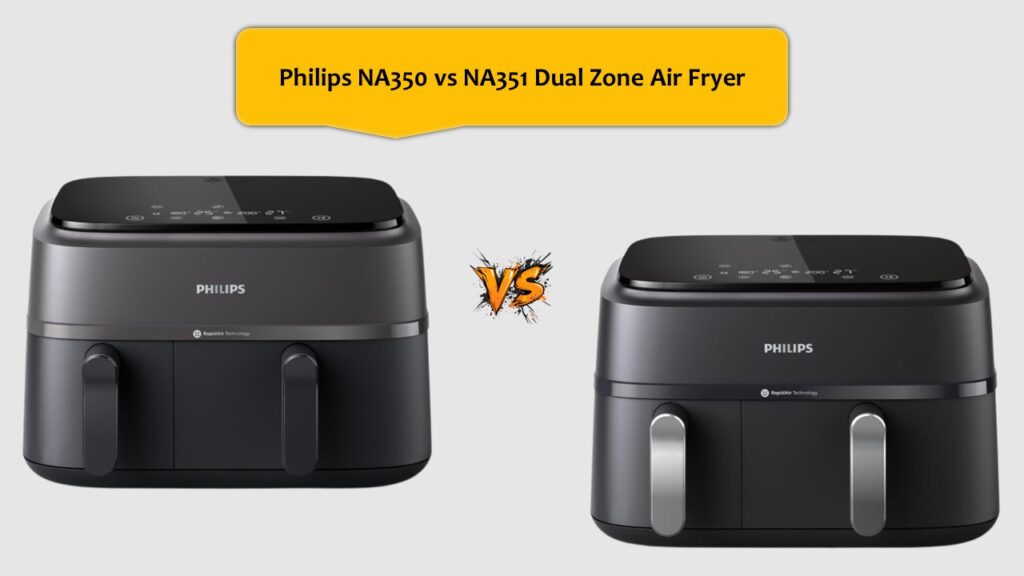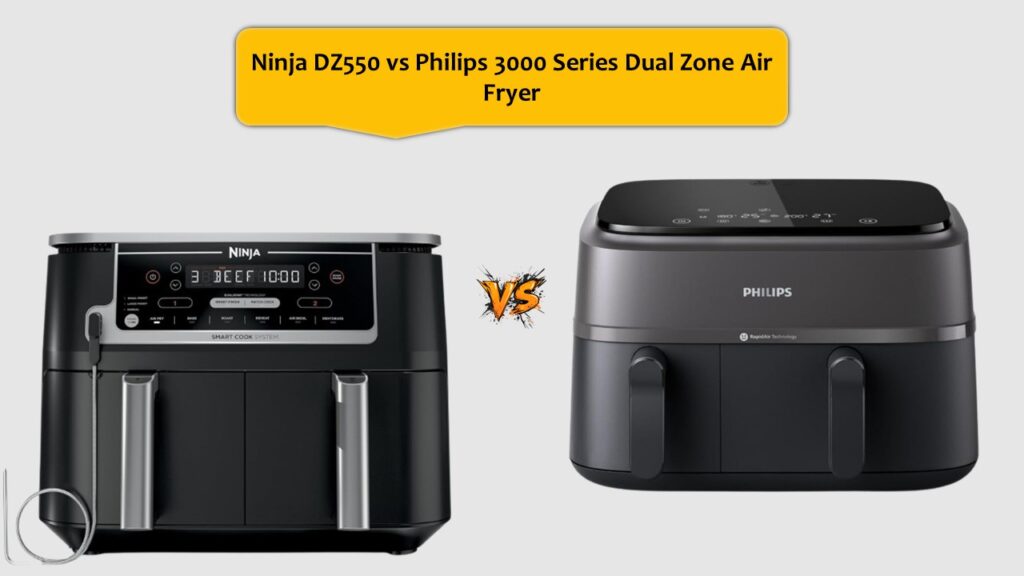
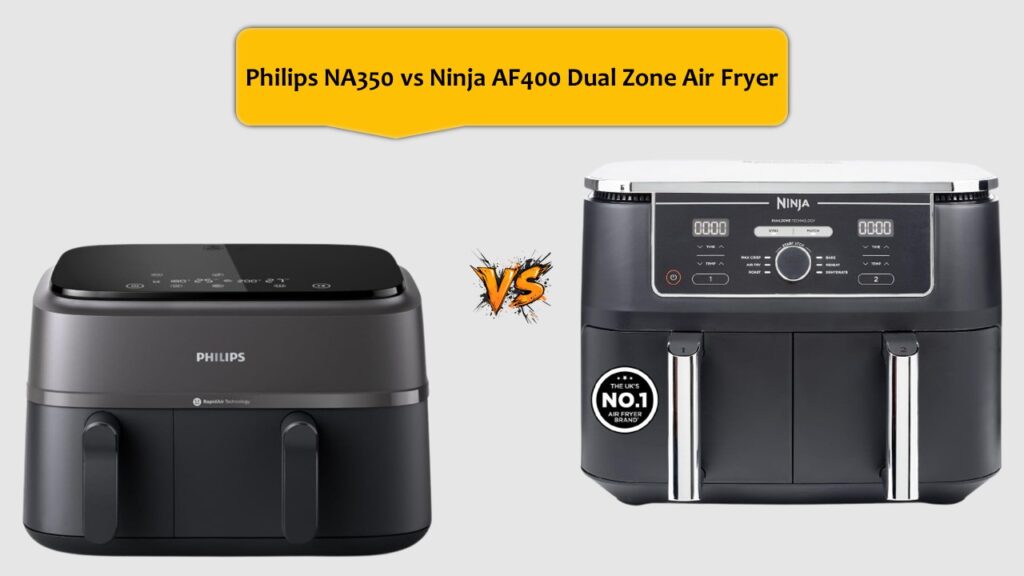
When I first placed the Philips NA350 and the Ninja AF400 side-by-side on my counter, I realized I was looking at two very different philosophies of air frying. The Ninja AF400 (The Foodi MAX) has long been the “Gold Standard” for dual-basket cooking—it’s the machine that popularized the whole idea of syncing two meals. On the other hand, the Philips NA350 is the challenger, bringing a unique “unequal drawer” design that tries to fix the one thing I’ve always found slightly annoying about the Ninja.
If you’re trying to decide which 9.5-liter titan is worth your investment, I’ve spent weeks testing everything from Sunday roasts to quick midnight snacks to see which one actually makes life easier.
The Key Difference: Symmetric vs. Asymmetric Cooking
The fundamental difference here is the drawer layout.
- The Ninja AF400 features two identical 4.75L drawers.1 It’s built for symmetry.
- The Philips NA350 features a 6L “Main” drawer and a 3.5L “Side” drawer. It’s built for a traditional “protein and veg” meal structure.
This choice changes how you interact with the machine every single day.

Philips Dual Basket Air Fryer - Healthy, Fast, and Versatile Cooking, 9.5QT Capacity, Touchscreen, 2-Drawer Design (NA350/00)
- COOK MULTIPLE DISHES SIMULTANEOUSLY - Enjoy crispy fries on one side and juicy chicken nuggets on the other, all at the same time.
- HEALTHY AND DELICIOUS FRIED FOOD - Rapid Air Technology circulates hot air around your food for crispy results with less oil.
Comparison Table: Philips NA350 vs Ninja AF400 Dual Zone Air Fryer
| Feature | Philips NA350 Dual Zone | Ninja Foodi MAX AF400 |
| Total Capacity | 9.5 Quarts (9 Liters) | 9.5 Liters |
| Drawer Design | Unequal: 6L Large + 3.5L Small | Equal: 2x 4.75L Drawers |
| Cooking Functions | 8-in-1 (includes Dehydrate/Proof) | 6-in-1 (includes Max Crisp) |
| Wattage | 1800 Watts | 2470 Watts (High Power) |
| Sync Feature | Auto-sync Cooking Time | SYNC and MATCH Cook |
| Cleaning | Dishwasher Safe | Dishwasher Safe |
| App Support | HomeID Recipe App | Recipe Guide Included |
| Check Price & Latest Deals | Buy on Amazon | Buy on Amazon |
Detailed Comparative Review: My Experience
Design and Footprint
The Ninja AF400 is a wide machine. It feels “professional” and sturdy, with a matte black finish and silver accents that have held up remarkably well against fingerprints. However, it takes up a serious amount of horizontal space.
The Philips NA350 is actually quite clever with its footprint. It’s a bit deeper but feels less like a “monolith” on the counter. The interface on the Philips is a sleek, flat touchscreen, whereas the Ninja uses a combination of a digital screen and a tactile dial. Personally, I find the Ninja’s dial faster to use when I need to jump from 150°F to 400°F quickly, but the Philips screen is much easier to wipe clean.
Philips Dual Basket Air Fryer - Healthy, Fast, and Versatile Cooking, 9.5QT Capacity, Touchscreen, 2-Drawer Design (NA350/00)
- COOK MULTIPLE DISHES SIMULTANEOUSLY - Enjoy crispy fries on one side and juicy chicken nuggets on the other, all at the same time.
- HEALTHY AND DELICIOUS FRIED FOOD - Rapid Air Technology circulates hot air around your food for crispy results with less oil.
Performance: Power vs. Airflow
This is where the wattage tells an interesting story. The Ninja AF400 draws significantly more power (2470W vs the Philips 1800W).
In my testing, the Ninja AF400 hit higher temperatures faster, especially when using the “Max Crisp” mode. If you’re cooking frozen foods like breaded chicken or thick-cut fries, the Ninja is a beast—it gets that “deep-fried” crunch better than almost any machine I’ve used.
The Philips NA350 uses its Rapid Air Technology, which focuses more on air circulation than raw heat.2 While it takes a minute or two longer to crisp up frozen nuggets, it cooks remarkably evenly. Because the 6L drawer is so large, I was able to roast a medium-sized whole chicken in the Philips with better airflow around the bird than in the narrower Ninja drawers.
The Reality of Two Drawers
Living with the Ninja AF400 means you have to think in “equal halves.” If you have a large main dish, you often have to split it between both drawers, which means you lose the ability to cook a side dish at a different temperature.
Living with the Philips NA350 feels more natural for a family dinner. I put the main meat in the 6L side and the asparagus or potatoes in the 3.5L side. I don’t have to compromise the “Main” just to have a “Side.” However, if you are a “Batch Cooker” who likes to make 2kg of chicken wings at once, the Ninja’s equal drawers are much better for shaking and even browning.
Ease of Use and Cleaning
Both machines feature a “Sync” function that ensures both drawers finish at the same time. It worked flawlessly on both.
When it comes to cleaning, the Philips baskets have a non-stick coating that feels slightly more premium and “slicker” than the Ninja. However, the Ninja’s crisper plates are very easy to pop out and throw in the dishwasher. After a month of use, I noticed fewer “burnt-on” spots in the Philips, but the Ninja’s components felt a bit more rugged for heavy-duty scrubbing.
Philips NA350 Dual Zone Air Fryer
Philips Dual Basket Air Fryer - Healthy, Fast, and Versatile Cooking, 9.5QT Capacity, Touchscreen, 2-Drawer Design (NA350/00)
- COOK MULTIPLE DISHES SIMULTANEOUSLY - Enjoy crispy fries on one side and juicy chicken nuggets on the other, all at the same time.
- HEALTHY AND DELICIOUS FRIED FOOD - Rapid Air Technology circulates hot air around your food for crispy results with less oil.
Pros:
- Asymmetric Drawers: The 6L drawer is a lifesaver for larger mains like roasts.
- Quiet Operation: Noticeably quieter than the Ninja during high-heat cycles.
- Modern Interface: Sleek touchscreen that is very easy to sanitize.
- Recipe App: The HomeID app is genuinely helpful for dual-zone beginners.
Cons:
- Lower Wattage: Takes slightly longer to reach “shatter-crisp” textures.
- Less Vertical Space: The drawers are deep but can feel cramped for tall items.
Ninja AF400 Dual Basket Air Fryer
Pros:
- Raw Power: The 2470W motor makes it one of the fastest air fryers on the market.
- Max Crisp Technology: Unbeatable for frozen foods and extra-crunchy textures.
- Batch Cooking: Equal drawers are better for cooking large quantities of the same food.
- Tactile Dial: Much faster to set time and temperature compared to tapping a screen.
Cons:
- Bulky Footprint: Requires a lot of dedicated countertop real estate.
- Loud Fan: It sounds like a small jet engine when both drawers are on “Max Crisp.”
The Verdict: My Recommendation
After putting these two through the wringer, the winner depends on how you plan to use it.
Choose the Philips NA350 if you are cooking traditional meals for a family. The 6L/3.5L split is much more practical for a “Main + Side” setup. It’s quieter, sleeker, and perfect for someone who wants an air fryer that feels like an extension of their oven.
Choose the Ninja AF400 if you prioritize speed and crunch. If you are a family of 4+ who eats a lot of frozen convenience foods, or if you like to cook massive batches of the same thing (like wings for game day), the Ninja’s power and equal-sized drawers are superior.
In my kitchen, I actually prefer the Philips NA350. The ability to fit a decent-sized roast in one side while keeping the other side free for a small portion of veggies just fits my cooking style better.
Philips Dual Basket Air Fryer - Healthy, Fast, and Versatile Cooking, 9.5QT Capacity, Touchscreen, 2-Drawer Design (NA350/00)
- COOK MULTIPLE DISHES SIMULTANEOUSLY - Enjoy crispy fries on one side and juicy chicken nuggets on the other, all at the same time.
- HEALTHY AND DELICIOUS FRIED FOOD - Rapid Air Technology circulates hot air around your food for crispy results with less oil.
Frequently Asked Questions (FAQs)
Q: Can I fit a whole chicken in the Ninja AF400?
A: You can fit a small chicken (around 1.2kg) in one 4.75L drawer, but it’s a tight squeeze. You’ll often get better results by spatchcocking the bird or using the larger 6L drawer in the Philips NA350.
Q: Does the Ninja AF400 use more electricity?
A: Yes, it has a higher wattage (2470W), which means it draws more power. However, because it cooks faster than many other models, the total energy usage per meal is often comparable to less powerful units.
Q: Is the Philips NA350’s 6L drawer big enough for a 9×13 baking dish?
A: No. While the 6L drawer is large for an air fryer, it is still a “drawer” shape. You can fit smaller silicone molds or 6-inch cake pans, but standard 9×13 dishes won’t fit.
Q: Which one is easier to “shake” mid-cycle?
A: The Ninja. Because the baskets are identical and balanced, they are very easy to slide out and shake. The 6L Philips basket can get quite heavy when full, making it a bit more of a workout for your wrist.